

A designer puzzle isn’t “collectible” because someone slapped limited edition on the box. It’s collectible when it keeps paying you back, visually, tactically, intellectually, long after the first solve and the first Instagram post.
I’ve kept a few puzzles in my own rotation for years, and the pattern is obvious: the ones that endure don’t just look good. They behave well. They age well. They still feel like the designer meant it.
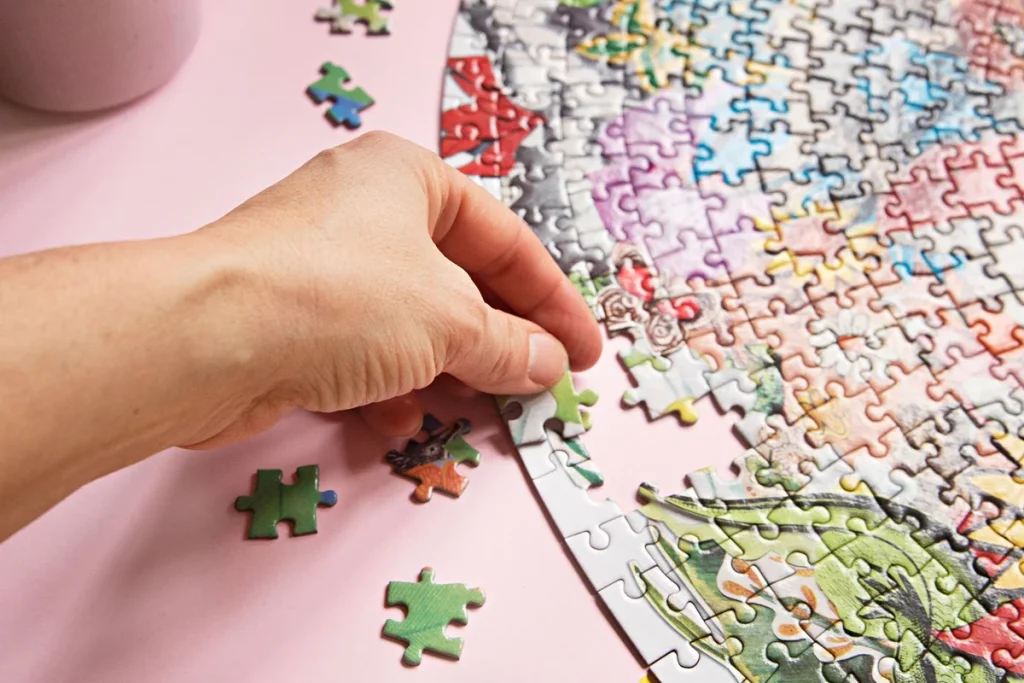
The honest frame: craft + concept + context (and none can be faked for long)
Here’s the thing. If you want a collection that doesn’t turn into a pile of hype artifacts, you need a stable rubric.
Craft is the evidence.
Concept is the reason.
Context is the afterlife.
Skip one and the puzzle might still be fun, but it won’t be durable as an object of design culture.
One-line truth: a collectible puzzle is a re-readable object.
If you’re interested in seeing this philosophy applied, explore modern designer jigsaw puzzles that elevate craftsmanship, concept, and context, all at once.
Aesthetics that aren’t just “pretty”
Some puzzles are decorative. Others are designed with an argument inside them.
When I’m judging the image, I’m looking for compositional intent, hierarchy, pacing, tension, negative space. Color balance matters, but not in the shallow “nice palette” way. A great designer puzzle uses color like a navigation system: anchors, transitions, feints. If the palette is doing nothing except being trendy, the replay value collapses fast.
Now, this won’t apply to everyone, but… if a puzzle’s main selling point is “so aesthetic,” it usually has about two solves in it before you’re bored.
A few tells that the art has real legs:
– A focal structure that rewards distance and close reading
– Repetition with variation (patterns that don’t flatten into mush)
– An identifiable voice, illustration, typography, collage, photography, without looking like a mood board
Craft, but make it measurable (specialist hat on)
You can talk about “quality” all day. I’d rather inspect it.
Die-cut precision is the big one. Clean cuts reduce fuzzing, preserve edge integrity, and prevent that irritating false-fit problem where pieces almost seat but not quite. Piece fit should be confident without being tight to the point of delamination. Thickness matters too; thin stock can look fine new and then turn flimsy after a few assemblies.
Materials are where designer puzzles separate themselves from gift-shop puzzles. You want:
– Archival board with consistent density (less warping, better long-term flatness)
– High-opacity inks with stable color (cheap blacks fade and muddy fast)
– A finish that matches the intent: matte for legibility and glare control; gloss only when the art really needs it
And yes, sustainability can be real rather than performative. Recycled board done well has a distinct hand feel, slightly warmer, often less resin-heavy (which some people prefer, some don’t). If the brand can’t tell you what they print with or where it’s made, I treat that as a yellow flag, not a moral failing.
A specific data point, because hand-waving gets old: according to Smithers’ The Future of Flexographic Printing Markets to 2026, packaging print markets have steadily shifted toward water-based and lower-VOC ink systems in response to regulation and brand pressure (Smithers, 2021). Puzzles aren’t packaging, but they live in the same print-production ecosystem, those supply chain changes show up in puzzle manufacturing choices too.
“Does it solve well?” is not a small question
A collectible puzzle has a solving rhythm. You can feel it in the first ten minutes.
Bad designer puzzles confuse “hard” with “obnoxious.” They rely on low-contrast gradients, mushy photography, or deliberately ambiguous piece shapes that create friction without meaning. That’s not difficulty; it’s hostility.
The good ones tend to follow a subtle arc:
Early game clarity.
Mid-game decision pressure.
Late-game inevitability.
If the mechanics align with the theme, you get something rare: a puzzle that teaches you how to see the image. The solving becomes interpretation, not just assembly.
Look, I’m fine with a brutal puzzle if it’s honest about why it’s brutal. A conceptual monochrome? Great. A maze-like die-cut that echoes the artwork’s geometry? I’m listening. But “we made it hard because collectors like pain” is a weak pitch.
Cultural resonance: the part collectors pretend they don’t care about (but do)
You don’t need a puzzle to be political or academically dense to have cultural weight. You just need it to be tethered to something bigger than itself.
Design history shows this again and again: objects become collectible when they carry references, art movements, production methods, typographic eras, regional aesthetics, subcultures, critiques of consumerism, whatever. Context turns a puzzle into a document.
Misalignment kills value. If the puzzle looks like it’s borrowing the language of Bauhaus or Swiss typography but the production is sloppy, you feel the fraud immediately. Spectacle doesn’t survive close touch.
Replay: the real durability test
A lot of puzzles are one-night stands.
A collectible puzzle is the one you pull out again because you remember how it felt to solve, where you got stuck, what surprised you, which sections clicked. Replay value comes from controlled repetition: motifs that reappear with slight shifts, compositional echoes, recurring tonal anchors.
I’ve seen collectors chase novelty like it’s a sport, then quietly sell half their shelves a year later. The puzzles that remain are almost always the ones with layered readability. Not necessarily the hardest. Just the richest.
(And yes, some people frame puzzles and never reassemble them. Fine. But if the puzzle can’t survive a second assembly without corner wear, fading, or piece-lift issues, it’s basically decorative paper.)
Editions, collaborations, rarity: where people lose their heads
Hot take: scarcity should increase your skepticism, not your excitement.
Limited runs can signal careful curation, smaller production, tighter quality control, deliberate audience. They can also signal artificial urgency. A collaboration with a respected artist means nothing if the printing and cutting are mid-tier.
I treat editions like provenance in the art world: useful only if documented and consistent.
What I’d actually track (yes, I’m that person):
– Edition size and whether it’s numbered or simply “limited”
– Release window and reprint policy (some brands quietly reissue)
– Condition notes: corner crush, box scuffing, piece lift, discoloration
– Inclusions: poster, certificate, artist statement, unique packaging elements
– Evidence of authentication when applicable (especially in cross-brand collabs)
A puzzle that shows up repeatedly in catalogs, resale listings, design blogs, or museum-shop ecosystems has a different kind of rarity: cultural persistence. That’s usually the one worth betting on.
A practical scoring framework (use it, tweak it, argue with it)
I like numbers because they force honesty. Here’s a clean starting grid, 10 points each:
- Image + artistic voice (0, 10)
- Concept strength: idea, coherence, interpretability (0, 10)
- Print quality: registration, color stability, finish (0, 10)
- Cut + fit: precision, false-fit resistance, piece feel (0, 10)
- Material longevity: board, wear resistance, storage resilience (0, 10)
- Solving rhythm: arc, fairness, intentional difficulty (0, 10)
- Context + resonance: references, cultural tether, design literacy (0, 10)
- Edition/provenance: documentation, run clarity, integrity (0, 10)
- Packaging as object: typography, structure, durability (0, 10)
- Replay pull: do you want to do it again? (0, 10)
You’ll notice “hype” isn’t on the list. That’s intentional.
The collection that lasts looks a little boring on paper
Not visually boring. Ethically boring. Structurally boring. As in: you can explain why each puzzle is there without resorting to “it sold out fast.”
If you can defend the craft, articulate the concept, and place it in context, you’re not just buying puzzles. You’re building a small design archive you’ll actually revisit.